

';
?>
';
?>
We feel devotion
DataCenter
WEEK ANALYSIS
Players Ranking Distribution
We break down the Index Rating into three main categories to define the fundamental fantasy components of Euroleague players.
Published: 22/10/2025 14:29
Many times in BasketStories columns we refer to a player’s stability or inconsistency, to shooters who depend heavily on their scoring — and therefore on how “hot” they are on a given night — as well as to the ability of some players to draw fouls, a quality we often emphasize as a luxury and a safety net for Fantasy managers when selecting their players. A detailed analysis of a player’s strengths and weaknesses is undoubtedly multidimensional but also extremely useful — both for team planning in the game and in pure basketball terms.
With this in mind, we introduce two new pages in the BasketStories Datacenter that offer greater clarity and accessibility to this information — that is, how much a player’s ranking depends on his scoring, and which core elements of his game contribute most to it. Specifically, we look at the ratio of ranking-to-points and at the distribution of ranking across three key categories.
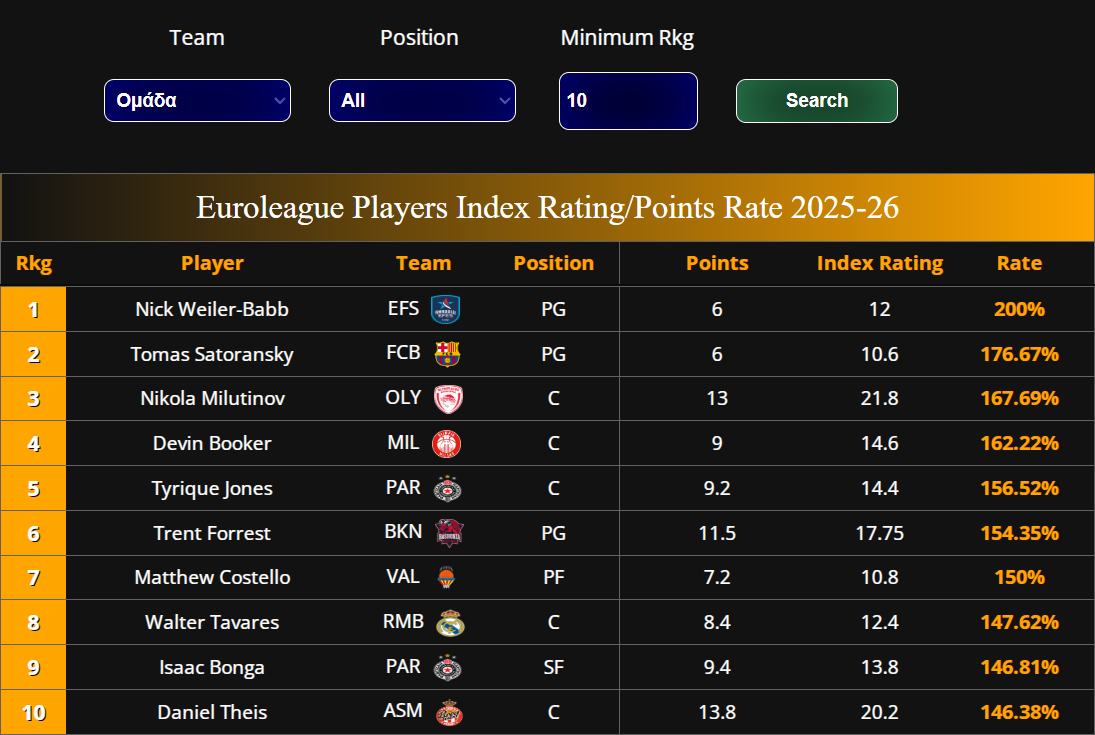
This ratio measures the percentage of a player’s ranking that comes from his points, revealing how dependent he is on scoring for his overall fantasy — and not only — performance.
The two most popular stats in the devotion community, points and Index Rating, are used here. This ratio essentially serves as a “safety indicator” of a player’s consistency and production under different circumstances. Naturally, this index tends to be higher for big men, since their ranking is boosted by rebounds and less reliant on volume scoring, unlike guards or shooters, whose contribution depends more heavily on their shot-making.
A typical example of the first case is Nikola Milutinov, who for years has posted high rankings without being among the top scorers. Indicatively, at this point of the season (after Round 5), his Rkg/Pts ratio is 167.7%, averaging 21.8 Index Rating and 13 points. And that’s after scoring 23 points in his latest game — which actually lowered the ratio! As a counterexample, Markus Howard has always been a prolific shooter, but without much contribution elsewhere. Currently, the Baskonia guard averages 7 points and 2.25 ranking, giving him an Rkg/Pts ratio of just 32.1%.
You can view this ratio for every Euroleague player in the BasketStories DataCenter on the dedicated page, as an extra tool to help shape your Euroleague Fantasy team.
You can also filter by team and position to narrow down your search, and set a minimum threshold for a player’s average ranking — for example, showing only those who are relevant Fantasy options.
Thus, while names like Diop, DiBartolomeo, Papagiannis, and Dokossi initially stand out, the first player with a double-digit ranking average in this ratio is Nick Weiler-Babb, who posts 6 points and 12 Index Rating, giving him a remarkable 200% Rkg/Pts ratio.
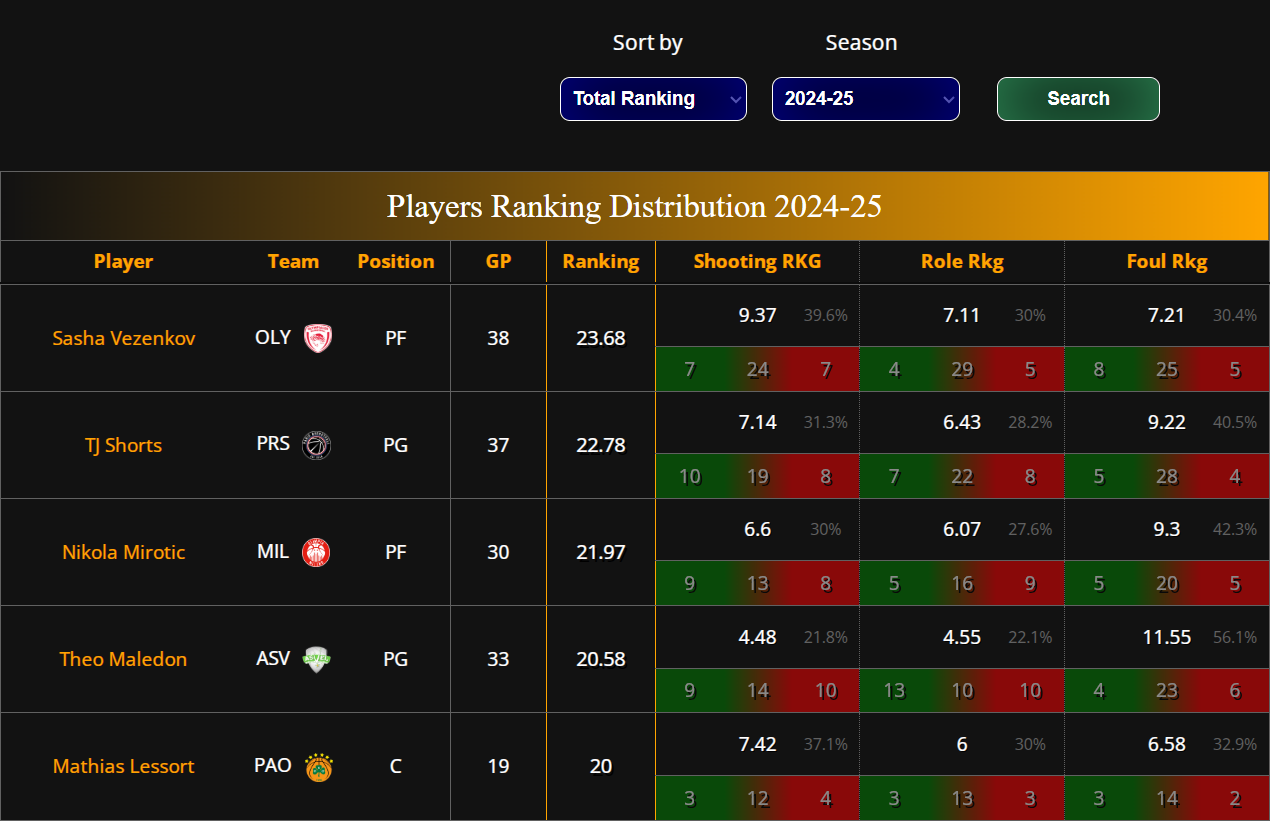
Beyond the relationship between ranking and scoring — which in many cases serves as a first measure of a player’s “safety” in Fantasy — we can take a step further and analyze how a player’s ranking is distributed across grouped statistical categories that make up his total Index Rating.
Thus, we divide ranking into three main components to analyze players through this lens and identify their strongest aspects. These are:
a) Shooting Ranking
b) Foul Ranking
c) Role Ranking
Shooting Ranking: the part of a player’s ranking that reflects his shooting efficiency and scoring execution.
It includes points from field goals (2P and 3P), missed shots, and shots blocked by opponents. In other words, this category covers a player’s shooting (excluding free throws), highlighting his connection with the basket — in both efficiency and volume — and is calculated simply by adding and subtracting the relevant stats:
(2FGM2 - (FGA2 - FGM2)) + (3FGM3 - (FGA3 - FGM3)) - BLA
(FGM2: made 2-pointers, FGA2: missed 2-pointers, FGM3: made 3-pointers, FGA3: missed 3-pointers, BLA: shots blocked)
Foul Ranking: the ranking derived from a player’s ability to draw and convert fouls.
In the Index Rating — and therefore in Euroleague Fantasy — one of the key differences compared to other evaluation systems is that fouls drawn are included in the final Index, making them a crucial component of a player’s score. This indicator can be calculated as the number of fouls drawn plus free throws made, minus missed free throws. So, for instance, a big man who draws many fouls but shoots poorly from the line won’t reach his full ranking potential.
FLD + FTM - (FTA - FTM)
(FLD: fouls drawn, FTM: made free throws, FTA: missed free throws)
Role Ranking: the ranking that represents a player’s overall contribution to his team’s game.
It includes all other offensive and defensive stats — rebounds (offensive & defensive), assists, steals, turnovers, blocks, and fouls committed:
OFR + DFR + AST + STL - TO + BLK - FL
(OFR: offensive rebounds, DFR: defensive rebounds, AST: assists, STL: steals, TO: turnovers, BLK: blocks, FL: fouls committed)
The Role Ranking could theoretically be split into defensive (defensive rebounds, steals, blocks, defensive fouls) and offensive (offensive rebounds, assists, turnovers, offensive fouls) components, but within Fantasy it’s likely sufficient to keep them together in a single index. A future update may explore this separation further.
It’s important to note that each main boxscore category appears only once across the three ranking types, so their sum equals the player’s total Index Rating.
It may seem curious that free throws are included in Foul Ranking rather than Shooting Ranking, but since the latter concerns field goals — the actual “execution” aspect — and free throws are directly tied to drawing fouls, they logically belong in the Foul Ranking.
Similarly, fouls drawn are separated from fouls committed, as the former relate to offensive aggression and getting to the line, while the latter are tied more to defensive roles (for example, a star player will draw more fouls, whereas a defensive specialist is more likely to commit them).
You can view the ranking distribution for all Euroleague players in the BasketStories DataCenter on the dedicated page, which lists every player along with his average in each ranking type. Next to each average, the percentage contribution of that ranking type to the player’s total ranking is displayed.
Additionally, below each ranking category average, you’ll find three numbers:
a) how many games the player exceeded that average by 50% (left value),
b) how many times he fell below 50% (right value), and
c) how many times he stayed between 50% and 150% of that average (middle value) — serving as a consistency check for that specific ranking type.
For example, Trent Forrest of Baskonia stands out for his all-around game, averaging 8.75 in Role Ranking but just 1.75 in Shooting Ranking, while Nick Weiler-Babb shows similar proportions at 6.2 and 1.8. High Foul Ranking contributors include De Colo (as always – 9), Horton-Tucker (8.67), and Dorsey (8.2), who benefits greatly from his free throw accuracy. In Shooting Ranking, players like Luwawu-Cabarrot (10.2), Clyburn (10.2), and Radio (9.3) stand out — especially compared to their averages in other ranking types — while stars who excel evenly across all three (take Milutinov as an example) have a more balanced distribution, making them safer Fantasy picks.
The page also includes corresponding stats from previous Euroleague seasons for comparison and insight — valuable both for Euroleague Fantasy players and basketball fans in general — and allows sorting players by ranking type.
Devotion.
With this in mind, we introduce two new pages in the BasketStories Datacenter that offer greater clarity and accessibility to this information — that is, how much a player’s ranking depends on his scoring, and which core elements of his game contribute most to it. Specifically, we look at the ratio of ranking-to-points and at the distribution of ranking across three key categories.
Ranking/Points Ratio
This ratio measures the percentage of a player’s ranking that comes from his points, revealing how dependent he is on scoring for his overall fantasy — and not only — performance.
The two most popular stats in the devotion community, points and Index Rating, are used here. This ratio essentially serves as a “safety indicator” of a player’s consistency and production under different circumstances. Naturally, this index tends to be higher for big men, since their ranking is boosted by rebounds and less reliant on volume scoring, unlike guards or shooters, whose contribution depends more heavily on their shot-making.
A typical example of the first case is Nikola Milutinov, who for years has posted high rankings without being among the top scorers. Indicatively, at this point of the season (after Round 5), his Rkg/Pts ratio is 167.7%, averaging 21.8 Index Rating and 13 points. And that’s after scoring 23 points in his latest game — which actually lowered the ratio! As a counterexample, Markus Howard has always been a prolific shooter, but without much contribution elsewhere. Currently, the Baskonia guard averages 7 points and 2.25 ranking, giving him an Rkg/Pts ratio of just 32.1%.
You can view this ratio for every Euroleague player in the BasketStories DataCenter on the dedicated page, as an extra tool to help shape your Euroleague Fantasy team.
You can also filter by team and position to narrow down your search, and set a minimum threshold for a player’s average ranking — for example, showing only those who are relevant Fantasy options.
Thus, while names like Diop, DiBartolomeo, Papagiannis, and Dokossi initially stand out, the first player with a double-digit ranking average in this ratio is Nick Weiler-Babb, who posts 6 points and 12 Index Rating, giving him a remarkable 200% Rkg/Pts ratio.
Ranking Distribution
Beyond the relationship between ranking and scoring — which in many cases serves as a first measure of a player’s “safety” in Fantasy — we can take a step further and analyze how a player’s ranking is distributed across grouped statistical categories that make up his total Index Rating.
Thus, we divide ranking into three main components to analyze players through this lens and identify their strongest aspects. These are:
a) Shooting Ranking
b) Foul Ranking
c) Role Ranking
Shooting Ranking: the part of a player’s ranking that reflects his shooting efficiency and scoring execution.
It includes points from field goals (2P and 3P), missed shots, and shots blocked by opponents. In other words, this category covers a player’s shooting (excluding free throws), highlighting his connection with the basket — in both efficiency and volume — and is calculated simply by adding and subtracting the relevant stats:
(2FGM2 - (FGA2 - FGM2)) + (3FGM3 - (FGA3 - FGM3)) - BLA
(FGM2: made 2-pointers, FGA2: missed 2-pointers, FGM3: made 3-pointers, FGA3: missed 3-pointers, BLA: shots blocked)
Foul Ranking: the ranking derived from a player’s ability to draw and convert fouls.
In the Index Rating — and therefore in Euroleague Fantasy — one of the key differences compared to other evaluation systems is that fouls drawn are included in the final Index, making them a crucial component of a player’s score. This indicator can be calculated as the number of fouls drawn plus free throws made, minus missed free throws. So, for instance, a big man who draws many fouls but shoots poorly from the line won’t reach his full ranking potential.
FLD + FTM - (FTA - FTM)
(FLD: fouls drawn, FTM: made free throws, FTA: missed free throws)
Role Ranking: the ranking that represents a player’s overall contribution to his team’s game.
It includes all other offensive and defensive stats — rebounds (offensive & defensive), assists, steals, turnovers, blocks, and fouls committed:
OFR + DFR + AST + STL - TO + BLK - FL
(OFR: offensive rebounds, DFR: defensive rebounds, AST: assists, STL: steals, TO: turnovers, BLK: blocks, FL: fouls committed)
The Role Ranking could theoretically be split into defensive (defensive rebounds, steals, blocks, defensive fouls) and offensive (offensive rebounds, assists, turnovers, offensive fouls) components, but within Fantasy it’s likely sufficient to keep them together in a single index. A future update may explore this separation further.
It’s important to note that each main boxscore category appears only once across the three ranking types, so their sum equals the player’s total Index Rating.
It may seem curious that free throws are included in Foul Ranking rather than Shooting Ranking, but since the latter concerns field goals — the actual “execution” aspect — and free throws are directly tied to drawing fouls, they logically belong in the Foul Ranking.
Similarly, fouls drawn are separated from fouls committed, as the former relate to offensive aggression and getting to the line, while the latter are tied more to defensive roles (for example, a star player will draw more fouls, whereas a defensive specialist is more likely to commit them).
You can view the ranking distribution for all Euroleague players in the BasketStories DataCenter on the dedicated page, which lists every player along with his average in each ranking type. Next to each average, the percentage contribution of that ranking type to the player’s total ranking is displayed.
Additionally, below each ranking category average, you’ll find three numbers:
a) how many games the player exceeded that average by 50% (left value),
b) how many times he fell below 50% (right value), and
c) how many times he stayed between 50% and 150% of that average (middle value) — serving as a consistency check for that specific ranking type.
For example, Trent Forrest of Baskonia stands out for his all-around game, averaging 8.75 in Role Ranking but just 1.75 in Shooting Ranking, while Nick Weiler-Babb shows similar proportions at 6.2 and 1.8. High Foul Ranking contributors include De Colo (as always – 9), Horton-Tucker (8.67), and Dorsey (8.2), who benefits greatly from his free throw accuracy. In Shooting Ranking, players like Luwawu-Cabarrot (10.2), Clyburn (10.2), and Radio (9.3) stand out — especially compared to their averages in other ranking types — while stars who excel evenly across all three (take Milutinov as an example) have a more balanced distribution, making them safer Fantasy picks.
The page also includes corresponding stats from previous Euroleague seasons for comparison and insight — valuable both for Euroleague Fantasy players and basketball fans in general — and allows sorting players by ranking type.
Devotion.


